|
News
Archive
A Genuine Set - 9 January 2023
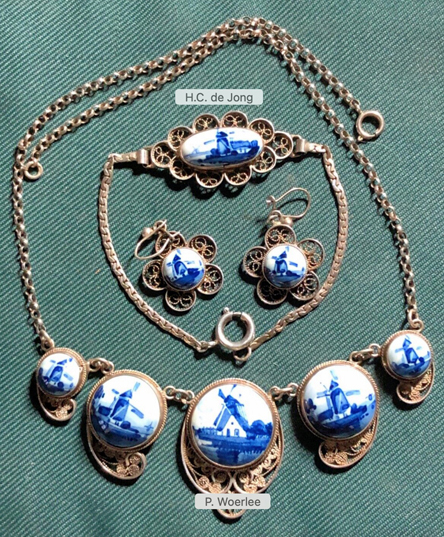
It is not often that ebay offers a Delft jewelry set that is really a set in the sense that all brooch panels are by the same maker, the Verwoerd Ceramics Studio. In addition, this lot illustrates the work of various Verwoerd decorators. One stone is by H.C. de Jong, active 1949-56, and one by P. Woerlee, active 1953-56. All other panels are by the studio's founder and owner Cornelis Verwoerd.
 |
The Manufacturers of Delft Cabs - 1 January 2022
What does a modeller do?
In the early 1940s Cornelis Verwoerd became the principal modeller of the Zenith pottery of Gouda, Netherlands. What does a modeller do? We can illustrate this with the attached photos of Verwoerd's work, an ashtray with a ship's image intended as a corporate gift article for the Hollandsche Stoomboot Maatschappij (HSM, Dutch Steamship Co). The client provides an image of one of its ships, for example in the form of a photo. Based on this, a design is made. In this case by the modeller, but often by a separate designer. The design is then submitted to HSM. They have made a final comment on the letter spacing. Next a three-dimensional plaster model is crafted that in turn can serve to make a plaster of paris mold for the ashtray. The result can be seen in the photo at the top left.
You can follow our series "The Manufacturers of Delft Cabs" at our Facebook page
Verwoerd Ceramics Online.
 |
The Delft Jewelry Collectors Guide - 13 January 2020
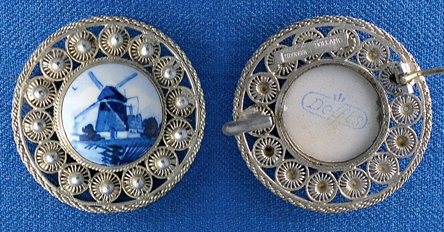
A good collection is like eating your cake and have it. But what is a good collection? Today starts the critically revised version of our successful series about collecting Delft Jewelry. We will deal with subjects like Decorators, Patterns, Silver & other metals, Factory marks, and Signatures. All in bimonthly instalments on our Facebook page Verwoerd Ceramics Online. Don't miss an episode. Thank you so much, and see you at Facebook @followvco.
 |
We could use some help - January 2019
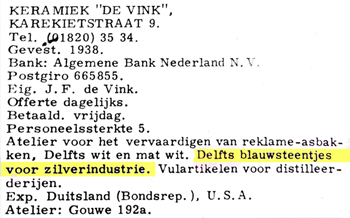
In our facebook blog of 28 January 2019 we have asked our readers to help identifying Delft brooch panels by “Keramiek De Vink” of Gouda. As our request is mostly for our Dutch friends, here is a full Dutch translation:
“Er zijn nog steeds Delftse brocheplaatjes die we niet hebben geïdentificeerd en we hebben uw hulp nodig. We laten een vermelding zien uit het "ABC voor Handel en Industrie" van 1966. Het betreft "Keramiek De Vink" uit Gouda die onder meer “Delfts blauwsteentjes voor zilverindustrie” vervaardigde. De Vink begon in 1938 als "Plateelbakkerij Uniek" onder leiding van M .Vuyk. In 1958 veranderde de naam in "Keramiek Uniek-De Vink" onder J.F. de Vink en H .Vuyk. In 1963 werd dit "Keramiek De Vink" onder J.F. de Vink. Delftse stenen worden genoemd vanaf 1966. We hebben waarschijnlijk brocheplaatjes van De Vink in onze collectie en er zijn mogelijk kenners onder onze lezers die ze kunnen identificeren, misschien afstammelingen van De Vink of (oud-)medewerkers van de zilverindustrie in Schoonhoven. Als u stenen van De Vink bezit of kunt herkennen, neem dan a.u.b. contact met ons op.”
 |
Anniversary Year 2018
This year we celebrate the 10 year anniversary our Museum site Verwoerd Ceramics Online, as well as the 5th anniversary of our facebook subsidiary. With the help of our friends and followers, we plan to soldier on and continue to provide you with our insights on Ceramics, Delft, and Delft jewelry in particular.
Both the museum site and our VCO facebook page have their specific role. This site serves as a reference on Delft and the Verwoerd Ceramics Studio, Gouda Potteries, Schoonhoven Silver Marks, all Verwoerd production models, both run-of-the-windmill and rare, and much more. On our facebook page www.facebook.com/followvco you'll find our running educational series, as well new acquisitions and news blogs. We would like to take this opportunity to thank you for your continuous and valuable support.
Another wonderful donation - January 2017
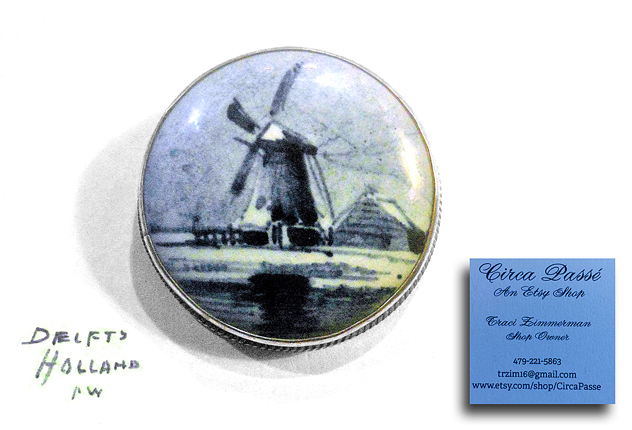
Traci Zimmerman, proud owner of Etsy shop Circa Passé, donated this intriguing 3.75 cm Winter Windmill brooch once belonging to her mother. It can be attributed to the Van Katwijk Studio of Gouda (1946-1999). It is an early piece (i.e. c.1946) and therefore the shade of blue isn't yet as bright as the later VK productions. Van Katwijk was still experimenting it seems. The decorator is Pieter Woerlee. We are extremely grateful to Traci for her kind and thoughtful gift to the VCO museum.
The Manufacturers of Delft Cabs - 19 December 2016
Today starts the critically revised version of our successful 2014 series about the makers of Delft brooch panels or cabochons on our Facebook page Verwoerd Ceramics Online. There will be a new blog each Monday. Don't miss an episode, and like us at the top of this page. Thank you so much, and see you at Facebook @followvco.
Follow VCO on Facebook: www.facebook.com/followvco
Our sister page “Verwoerd Ceramics Online” on Facebook celebrates yet another anniversary. It has proven to be a great addition to this our main reference website Verwoerd Ceramics Online. It is also more flexible, and therefore an excellent platform for discussing Delft silver jewelry, other Delft objects, related items and events, and answering your questions. We will continue to do so if all is well. To our friends and followers: thank you so much, and thank you for liking our page www.facebook.com/followvco
Happy Anniversary
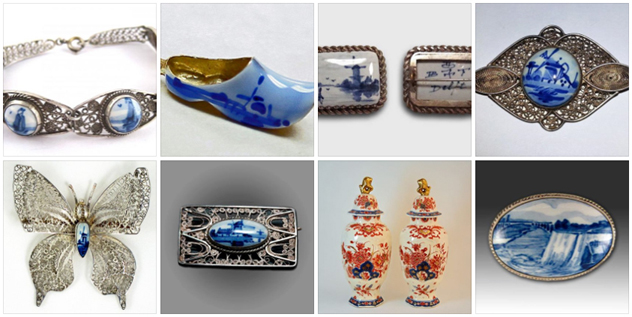
It is hard to believe that our facebook page “Verwoerd Ceramics Online” page started only 1 year ago. Now, some 150 pictures, as much original blogs, and numerous likes later you helped to convince us that this is a great way to share our latest finds and insights, and an excellent addition to our main reference website verwoerdceramics.com. To our friends and followers: thank you so much, and thank you for liking our VCO Facebook Page.
 |
Follow us on Facebook - December 2013
As from 20 December 2013 Verwoerd Ceramics Online can be followed on Facebook. Our VCO Facebook Page offers a wealth of new possibilities, and will live side by side with our regular Museum site. Updates are posted frequently, and highlight various aspects of the world of Delft and Delft jewelry. We will present items from our collection, point out auction listings that have an educational value, discuss collecting issues, and respond to your questions. We we will be able to share our answers with all our facebook friends. We encourage our visitors to like us on facebook. Simply click the like button at the top of this page. Enjoy!
On Display Now: "Verwoerd 100th Anniversary Offer" - February 2013
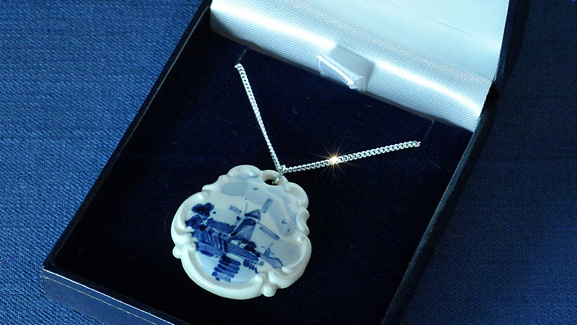
Our new exposition features a remarkable find, and a once in a lifetime offer. The 1952 Porcelain Painting Pendant or Plaque Pendant by the Verwoerd Ceramics Studio is a well documented design. It can be seen as a miniature version of the famous wall hanging porcelain paintings made by Delft potters in Holland from 1660 onward, and it is extremely rare. However, our unremitting research has recently recovered a true treasure trove with a small number of untouched, vintage 1952 Verwoerd Delft Plaque Pendants. We feel that, on the occasion of the 100th Verwoerd birthday, this should be shared with other collectors. Visit our On Display Now Sales Exposition, and learn more about this rare example of the combined skills of Verwoerd as a designer, modeler, and Delft painter.
 |
"Dutch and Schoonhoven Silver Marks" updated - July 2012
Further research allowed us to add two more maker's marks that have been used after 1940 by the silversmithing firm of Hubert Hooykaas, of Schoonhoven. We have also added four maker's mark by Zilverfabriek Nieuwpoort, owned by the Baardwijk family. Nieuwpoort is a small Dutch village on the left bank of the river Lek, opposite of Schoonhoven. Their silversmiths are generally considered part of the Schoonhoven silversmithing community. Click here to view our updated silver marks section.
"Verwoerd Ceramics Online" renovated - July 2012
Over the years of its existence Verwoerd Ceramics Online has evolved into an unique knowledge center on Delft jewelry. "The Compact Guide To Delft Jewelry Signatures" that started out as a special exhibition has rapidly become one of our most popular online publications. Other visitors' favorites are "Dutch and Schoonhoven Silver Marks" and "The Gouda Pottery List". We have decided to carry through several changes in recognition of this stimulating development. Frequently visited links have been moved to the top menu bar, and all Verwoerd Studio sub items have been regrouped at the top of the side bar. At the same time all texts have been critically reviewed, and actualized where necessary. It goes without saying that "The Compact Guide To Delft Jewelry Signatures" will be there to stay.
A wonderful donation - April 2012
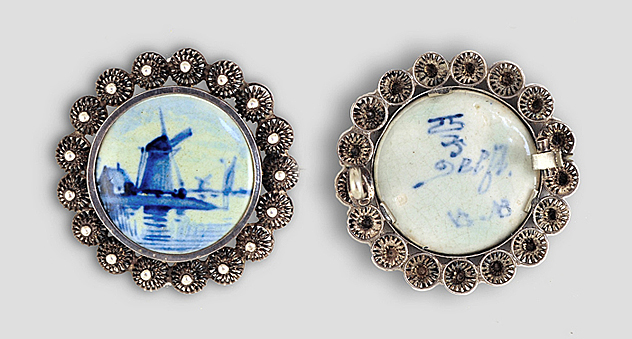
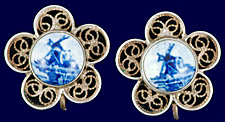
Verwoerd Ceramics Online regularly makes acquisitions for its reference collection. The latest addition came about in a very special way. The museum has received the silver filigree screw-back earrings illustrated here as a donation from Ms LeeAnn Welles-Beer of Ontario, Canada. The earrings are from the belongings of her late mother, who was a retired antique restorer, and a life long collector. We attribute the earrings to the former Van Katwijk workshop of Gouda, Netherlands, c.1953. We are extremely grateful to LeeAnn for her kind and thoughtful gift.
 |
"The Gouda Pottery List" updated - April 2012
We have added an entry for pottery WIGO, of Gouda, Netherlands, thus bringing The Gouda Pottery List total to 150. WIGO is established in 1971 by J.J. (Hans) de Wit, formerly employed with Amfora of Gouda. The new factory becomes a major player in the market for cast earthenware flower pots. Other products are lamp bases, and animal figurines. In 1989 the firm moves to the village of Waddinxveen, near Gouda, where it continues for another 9 years. This is partly research in progress, and Verwoerd Ceramics Online is very grateful to former WIGO employee, and expert plaster modeler Alex Meewezen for providing most of the present information.
"Delft Jewelry Signatures" - April 2012
Our new presentation is a compact guide to all major manufacturers of
Delft stones, and the signatures by which they can be identified.
There is no harm in a little help in this respect. Interpreting
signatures on many Delft medallions isn't straightforward. If there is
a signature, it may simply say 'Delfts' or 'Delfts Holland'. Any
addition is a bonus. This is especially true for the specialist
producers of Delft stones, such as Verwoerd, Van Katwijk, and
Olthuysen. The reason is that Delft jewelry inserts are in fact
intermediate products and their manufacturers were primarily known to
the silversmith clients. These well kept trade secrets can now be
revealed. The larger factories such as Royal Delft, Plateelbakkerij
Delft, Zenith, Schoonhoven, and Goedewaagen, who commonly sold a broad
product line under a well established brand name, can more easily be
identified if you know what to look for. All feature in our "Compact Guide To Delft Jewelry Signatures".
On Display Now: "Rare Delft Sailboats" -
October 2011
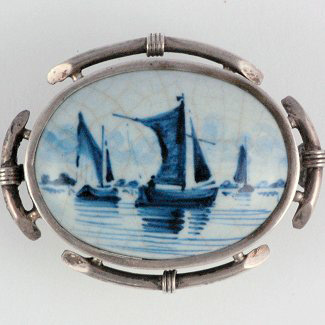
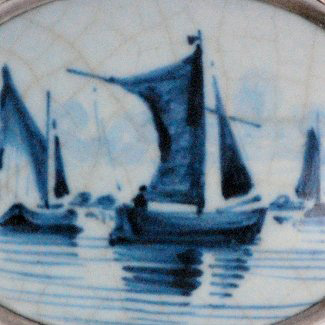
Our new exposition features Delft medallions that have been decorated
with blue and white sailing boat scenes. Flat bottom sailing vessels
once were the main means of transport on Dutch lakes, rivers, and
canals. Today they are broadly appreciated and admired as an important
part of our Dutch heritage. However, as a Dutch symbol abroad, the
little blue ships were never on a par with windmills, tulips, or clogs.
As a result hand painted Delft sailboat jewelry is
today relatively rare. For this online exhibition we have made a
selection from our museum collection with, amongst others, a late 19th
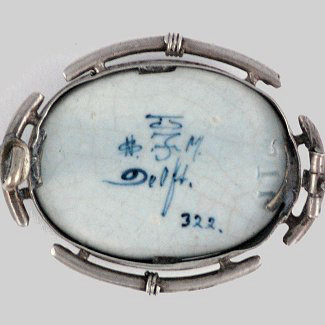
century Japonaiserie ships brooch from the
Porceleyne Fles factory in Delft.
 |
|
|
|
Silver
Brooch 1891
De Porceleyne Fles
Decorator NS
3.2x4cm
|
"The Gouda Pottery List" updated - May 2011
The museum has acquired Delft pottery inserts produced by J.
Nuvelsteijn of Gouda. The Nuvelsteijn firm was established before WW2,
and remained in business until about 1960-1970. Our new acquisitions
stem from that last decade, and there are presently no indications of
an earlier production of Delft stones. The inserts have been decorated
in the ligne clair style, but are easily recognized
by the fact that they are covered with a blueish transparent glaze, both
on front and back. Click
here to view the Nuvelsteijn entry in The Gouda Pottery List.
On Display Now: "Filigree and Imitation
Filigree" - April 2011
The VCO museum is pleased to present its new section of changing
exhibitions dedicated to selected pieces from our collection. The
opening exhibition of On Display Now features three
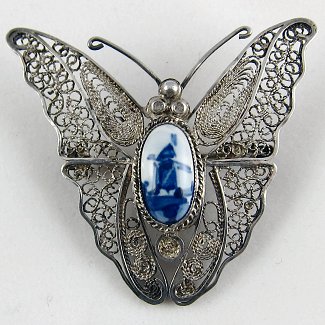
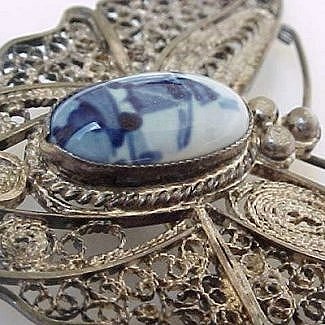
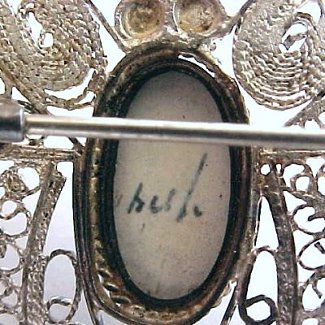
butterfly brooches. The items can be viewed from different angles, and
they illustrate three episodes from the production history of Delft
jewelry. First, the era of genuine, handcrafted filigree, mainly from
Schoonhoven. Each piece is meticulously composed of a large number of
tiny silver curls and other silver elements (see below). The 1960's see
the competition of die-cut silver toned metal, often made of aluminum
and other non-precious metals. In the 1980's Schoonhoven uses silver
lost wax casting techniques to produce crafty silver filigree
imitations that bring back some of the memories of times past.
 |
|
|
|
1950's
Silver Filigree
Butterfly Brooch
Cornelis Verwoerd/
G.J. van den Bergh
& Zn (attrib.)
4.7x4.7cm
|
"Schoonhoven Silver Marks" - October 2010
The VCO museum is pleased to present its list of maker's marks used by
Schoonhoven silversmiths after WW2. Our new addition can be very
helpful when dating Delft jewelry, and is useful for a broader group of
Schoonhoven silver collectors as well. Maker's marks usually mirror the
active period of a silversmith. They often reflect family events and
changes of management. Moreover, in 1953 Dutch silver hallmarks have
been adjusted to international standards, thus creating a clear
division of silver items produced before and after. Some of the
Schoonhoven silversmiths known to have been active in the production of
Delft jewelry are G.J. van den Bergh Jr., G.J. van den Bergh &
Son, G.A. van Engelen, the Niekerk Bros., W. Rond, H.B. Hol, H.
Hooykaas, the Huisman Bros, the Rous family, the Seton Bros, and the
Wendels family. They all feature in a new section of Verwoerd Ceramics
Online.
"The Gouda Pottery List" updated - July
2010
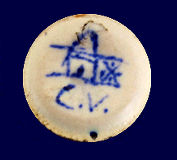
We have added an illustration of a small PZH trinket vase or bibelot
decorated by Cornelis Verwoerd at the age of 14. Verwoerd became a
painter's apprentice with Plateelbakkerij Zuid-Holland, of Gouda, the
Netherlands in 1927. The vase must have been one of his first finished
products. It is remarkably well done, and we take it that further
training was aimed at decorating larger pieces, and a larger number of
pieces in a given amount of time, while preserving quality. As
illustrated below, the marks at the bottom of the small vase are a
still very insecure painter's signature C.V., the year mark for 1927,
and the familiar PZH Lazarus Gate factory logo. Click here to view the PZH entry
in The Gouda Pottery List.
 |
"The Gouda Pottery List" - April 2010
The Verwoerd Ceramics Studio was not the only Gouda pottery that has
been started or revived after World War 2. Both the end of the war and
a newly sprung supply of affordable electrically heated pottery kilns
have caused a brief but impressive revival of the Gouda pottery
industry. Our research has revealed that in the 1950's, at the height
of the revival, some 90 potteries have been simultaneously active
within the Gouda region alone. All-in-all we have collected basic data
of over 140 predominantly small potteries, in most cases including the
names of their owners, the active period, their place of business, and
the nature of their production. Among the potteries that have produced
Delft medallions for application in silver jewelry are Cornelis
Verwoerd, Frans van Katwijk, Porceletti, Schoonhoven and Zenith. They
all feature in a new section of Verwoerd Ceramics Online "The Gouda Pottery List".
"The Verwoerd Painters" section updated -
January 2010
We have once more updated the paragraph on Ton de Kruyf. We now attach
less importance to the curved brake cord, and more
to the signature and the sketchy little windmill at the horizon. Our
research has further revealed that Piet Woerlee (1886-1963) not only
was a free lance decorator for Verwoerd, but for Van
Katwijk as well. We have updated the Woerlee
résumé accordingly. Frans van Katwijk was the
artistic leader and chief decorator at Plateelbakkerij
Schoonhoven. In that capacity he employed both Woerlee and
Verwoerd during the years 1937-1939. It is no surprise that Van Katwijk
hired the then free lance decorator Woerlee when he had established his
own company "Atelier Van Katwijk" in 1946, one year after the end of
the German occupation of Holland. The date at which Woerlee started
painting for Verwoerd, 1953, suggests that he ended his Van Katwijk
engagement after the untimely decease of Frans van Katwijk in November
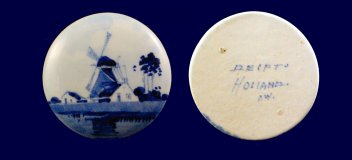
1952. Woerlee signs "PW", and there is no Van Katwijk factory mark as
illustrated below (courtesy Mr and Mrs J. Heikoop).
 |
Presenting "The Sepia Collection" -
October 2009
A remarkable discovery was made during a research visit to G.J. van den
Bergh Zilverwerken, of Schoonhoven, the Netherlands. The sepia
collection is a beautifully crafted four piece silver filigree sample
collection, featuring extremely rare sepia Delft medallions that have
been hand painted by Cornelis Verwoerd. The character of the paintings
is dramatically different from that of the more common blue and white
windmill sceneries. They resemble a wash pen and ink drawing rather
than a watercolor painting as is the case with most Verwoerd blue and
whites. This beautiful collection was produced in 1954 by silver smiths
G.J. Van den Bergh Jr. What has been preserved of this rare Sepia Delft
jewelry collection emerged in 2009, after having been hidden in the Van
den Bergh vault for 55 years. They now feature in our new exhibition "The Sepia Collection"
"The Painters" section updated - May 2009
The museum is pleased to announce that it has acquired a period
photograph of A.G. (Ton) de Kruyf, who was a free lance painter for the
Verwoerd Ceramics Studio during the years 1955 and 1956. The photo is
essential for the completion of our hired painters section. We have
also clarified the text about recognizing a "De Kruyf", in order to
underline that a windmill showing a "curved brake cord" is in itself
not sufficient to attribute the painting to Ton de Kruyf. Several other
painters - not in any way connected to the Verwoerd workshop - have
used the curved brake cord as well. It is therefore important to
consider this design always in combination with one or more additional
distinguishing features, such as the typical Verwoerd palette of blue
shades, a possible De Kruyf signature, or the proper silver smith
maker's mark. Please contact our helpdesk for further details.
Painters Résumés
added - April 2009
Recent research has enabled the Verwoerd Ceramics Online museum to add
a new page with résumés of the four painters that
have been employed by the Verwoerd Ceramics Studio. They are H.C de
Jong, P. Woerlee, Ms A.J. Gaasenbeek, and A.G. de Kruyf. Most Delft
medallions that have been produced by the Verwoerd workshop were
designed, manufactured, and painted by Cornelis Verwoerd. However, from
the very start Verwoerd has employed selected painters in order to meet
the demand for its high quality hand painted cabochons. Between 1949
and 1959, some 20 painters were asked to submit test samples of Blue
Delft windmill sceneries using bisque medallions and paint provided to
them. Only four painters were actually hired. With our new addition "The Painters" the museum aims to
recognize their contribution, and assist in identifying their work.
Production Data added - December 2008
The Museum has recently acquired historic production data of Delft
miniature medallions, as well as contemporary ceramic jewelry, from the
Verwoerd workshop over the period 1949-1975. We have analyzed this
information, and although the data for the early years are somewhat
fragmented, we are now in a position to indicate in most cases which
shapes or designs are special, and which are more common. This is very
relevant to our own collection, but also for other collectors. We have
therefore added the new information to the pages on the Windmill
series, the Rare Designs collection, and the Contemporary Jewelry
collection. Thanks to this find, we may also be able to provide more
detailed answers at our Helpdesk.
Back
to the top
|